How Do You Evaluate an AI or LLM System?
Building an AI system is not enough—you need to measure how accurately, reliably, and safely it performs. Learn the key metrics and methods used to evaluate modern AI and LLM applications.
RAG and Fine-Tuning solve different AI problems. RAG gives a model access to external knowledge, while Fine-Tuning adapts the model's behavior through additional training.
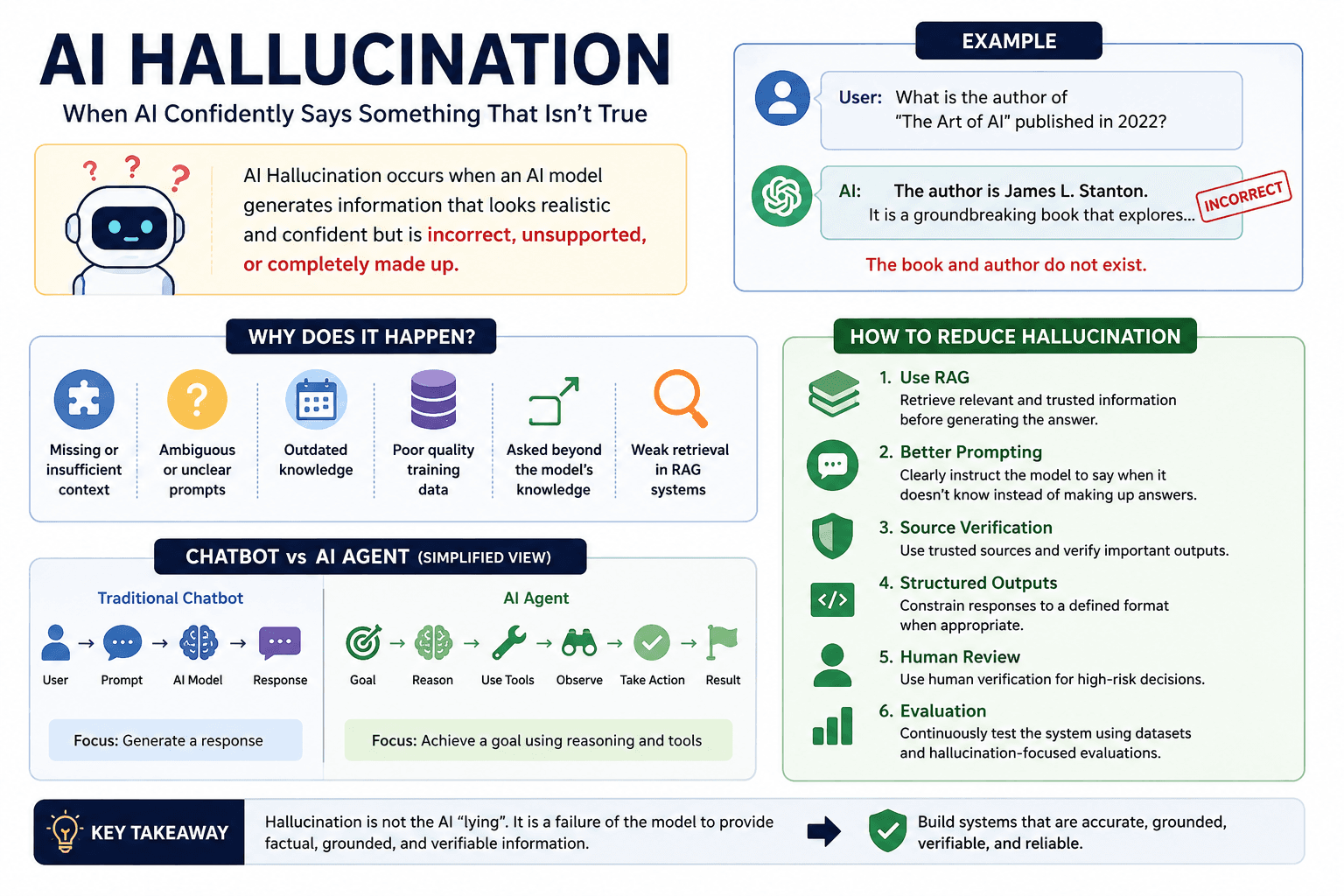
AI hallucination occurs when an AI model generates information that sounds convincing but is incorrect, unsupported, or fabricated. Learn why hallucinations happen and how production AI systems can reduce them.
RAG and Fine-Tuning solve different AI problems. Learn how they work, when to use each approach, and why RAG is often better for applications that need frequently changing or private knowledge.
An AI model, an AI API, and an AI application are different layers of an AI system. Understanding how they work together is essential for building real-world AI applications.
Zero-Shot, One-Shot, and Few-Shot Prompting are techniques for guiding LLMs with different numbers of examples. Learn how they work and when to use each approach.
Fine-Tuning and Prompt Engineering are two distinct approaches to improving AI model performance. Learn how they work, when to use each approach, and the key differences between them.
AI Agents go beyond simple chatbots by understanding goals, planning tasks, using tools, and taking actions. Learn how AI Agents work and how they differ from traditional chatbots.
Retrieval-Augmented Generation (RAG) combines information retrieval with Generative AI to help an LLM answer questions using relevant external information. Learn how RAG works, why it is useful, and when you should choose RAG for an AI application.