RAG vs Fine-Tuning: What's the Difference and When Should You Use Each?
RAG gives a model the right knowledge at the moment it answers. Fine-tuning changes how the model behaves. Learn the difference, when to use each, and when to combine them.
RAG vs Fine-Tuning in One Line
This is one of the most common Generative AI interview questions, and the short answer is:
RAG changes what the model knows at answer time. Fine-tuning changes how the model behaves.
Both can make an AI application better, but they solve different problems. Let's look at each.
What Is RAG?
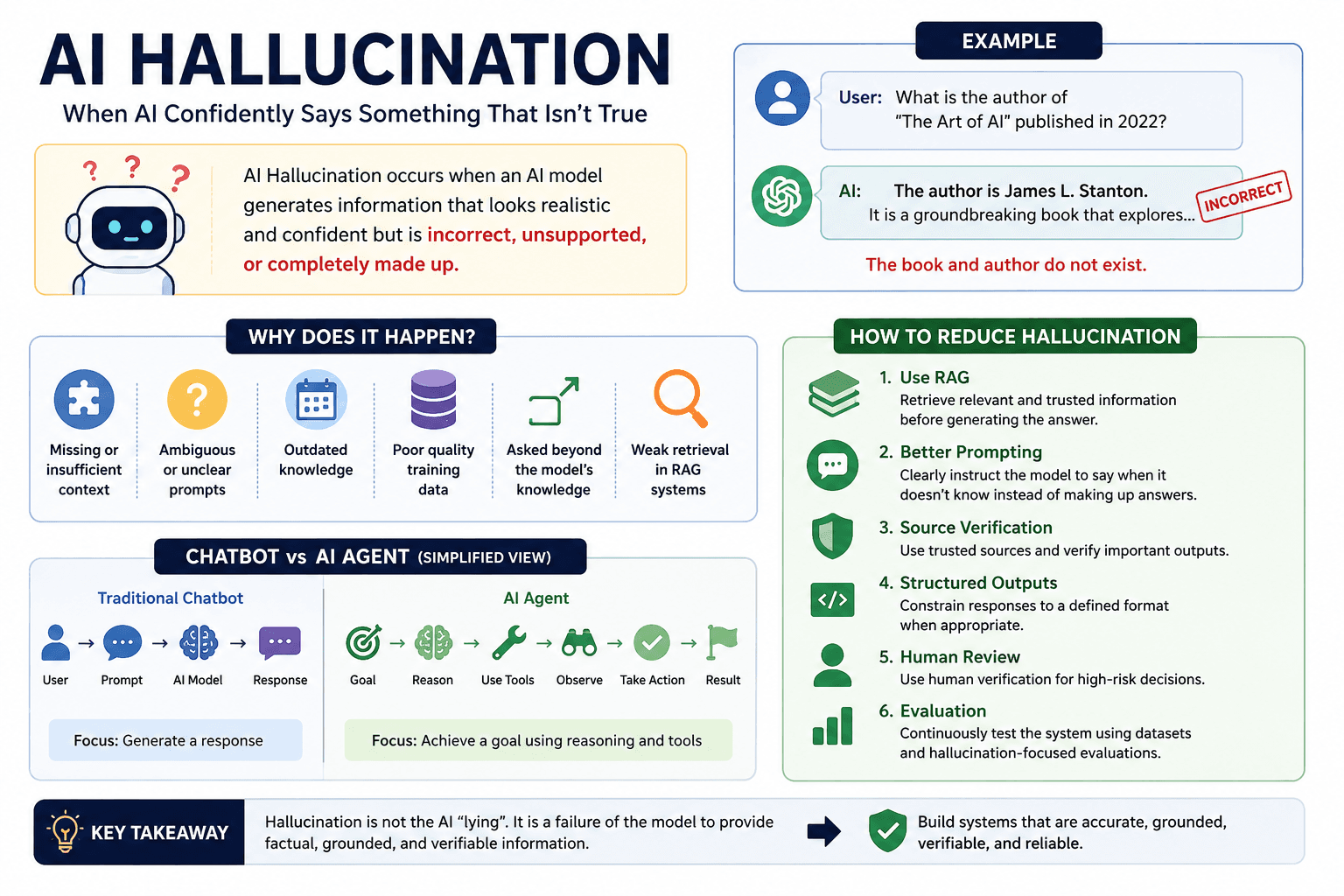
RAG (Retrieval-Augmented Generation) finds relevant information from an external source and gives it to the LLM as context, right when the question is asked. The model itself does not change.
Documents → Chunks → Embeddings → Vector Database → Retrieve relevant chunks → LLM → Answer
RAG is a strong fit for:
Private company documents and internal policies
Information that changes often (prices, rules, product details)
Knowledge bases and documentation
Answers that must show their sources
What Is Fine-Tuning?
Fine-tuning means taking a pretrained model and training it further on task-specific examples. This updates the model's parameters, so it learns a style, format or specialised behaviour.
Training examples → Fine-tuning → Adapted model → Better at one specific task
For example, a company might fine-tune a model on thousands of labelled support tickets so it classifies new tickets consistently.
Side-by-Side Comparison
RAG | Fine-Tuning |
|---|---|
Adds external knowledge at runtime | Changes the model through extra training |
Does not modify model weights | Updates model parameters |
Update knowledge by updating documents | New knowledge needs another training run |
Can show source documents | Does not provide sources by itself |
Needs retrieval infrastructure | Needs training data and compute |
Best for private or changing information | Best for consistent style or specialised tasks |
Which One Should You Use?
Choose RAG when…
Your knowledge changes frequently
You need answers from private documents
You need citations or traceability
You don't want to retrain whenever information changes
Example: an HR assistant answering from the company's latest leave policy. Policies change, so RAG is the better choice.
Choose fine-tuning when…
You need a consistent output style or format
You have a well-defined, repeated task (like classification)
Long prompts are not enough to get reliable behaviour
Can you use both?
Yes. Many production systems combine them:
Fine-tuning → teaches the model how to behave
RAG → gives the model what it needs to know
In practice, most teams start with good prompts and RAG, and fine-tune only when that is not enough.
Interview Tip
Don't say “RAG is better than fine-tuning” or “RAG adds knowledge to the model permanently.” Both are wrong. RAG supplies information during inference; the model's weights stay the same.
A strong answer:
“RAG provides relevant external knowledge at inference time, while fine-tuning adapts the model's behaviour through additional training. I choose based on the problem, and they can be combined.”
Key Takeaway
A good AI engineer doesn't ask “Which is better?” but “What problem am I solving?” That answer tells you whether you need better prompts, RAG, fine-tuning, or a mix.
Want to build this yourself? You will build a working RAG pipeline step by step: chunking, embeddings, retrieval and evaluation. Start the free course AI Engineering with LLMs: Beginner.
Related articles
More in Generative AI
Comments
Sign in to join the discussion.