RAG vs Fine-Tuning: What’s the Difference and When Should You Use Each?
RAG and Fine-Tuning solve different AI problems. RAG gives a model access to external knowledge, while Fine-Tuning adapts the model's behavior through additional training.
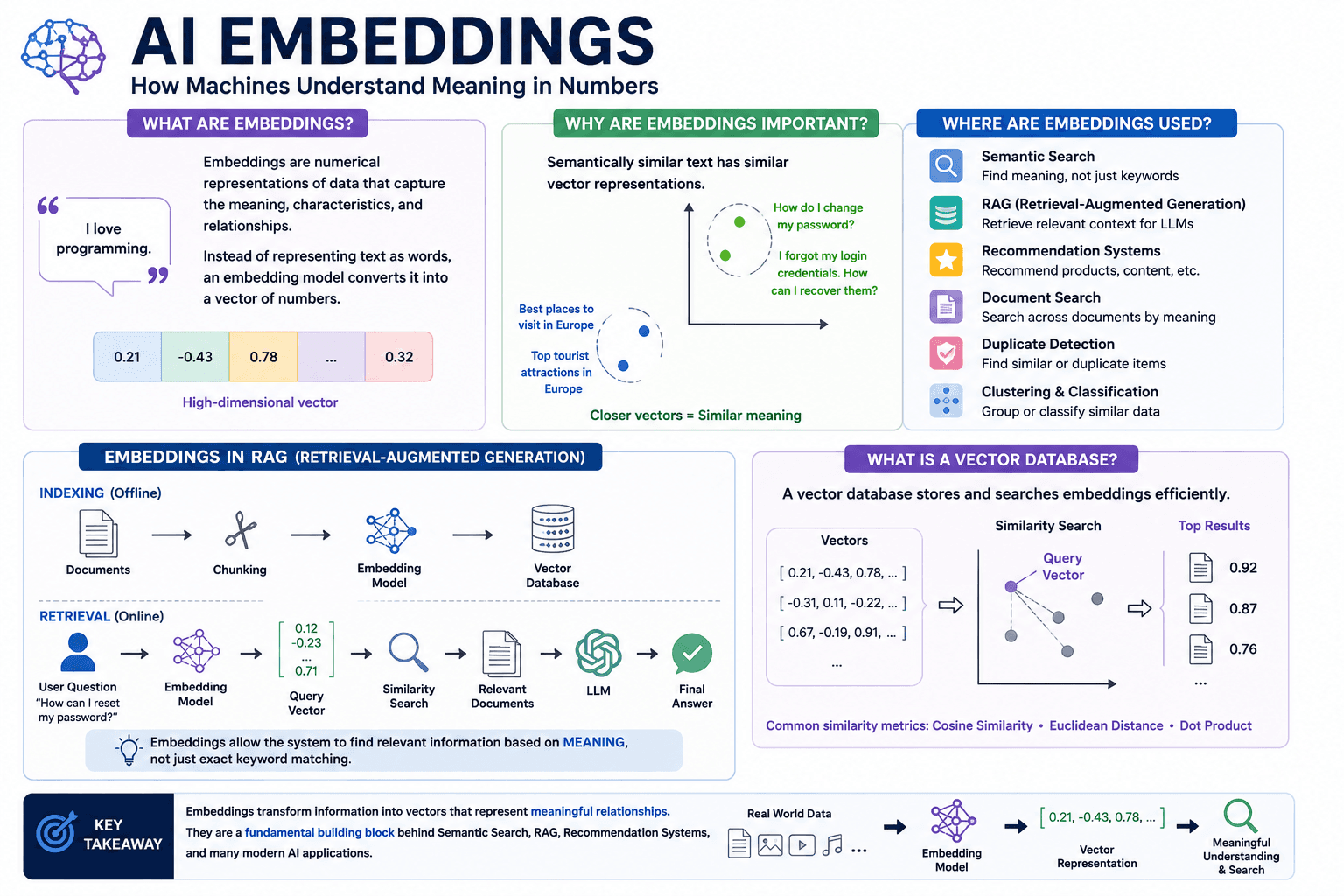
Embeddings convert text, images, or other data into numerical vectors that capture semantic meaning. Learn how embeddings power semantic search, RAG, recommendations, and modern AI applications.
RAG and Fine-Tuning solve different AI problems. Learn how they work, when to use each approach, and why RAG is often better for applications that need frequently changing or private knowledge.
A context window defines how much information an LLM can process at one time. Learn what tokens and context windows are, why they matter, and how they affect AI application performance.
Semantic Search finds information based on meaning and context rather than exact keywords. Learn how embeddings and vector search make modern AI-powered search more intelligent.
AI Agents go beyond simple chatbots by understanding goals, planning tasks, using tools, and taking actions. Learn how AI Agents work and how they differ from traditional chatbots.
Retrieval-Augmented Generation (RAG) combines information retrieval with Generative AI to help an LLM answer questions using relevant external information. Learn how RAG works, why it is useful, and when you should choose RAG for an AI application.