RAG vs Fine-Tuning: What’s the Difference and When Should You Use Each?
RAG and Fine-Tuning solve different AI problems. Learn how they work, when to use each approach, and why RAG is often better for applications that need frequently changing or private knowledge.
RAG vs Fine-Tuning
One of the most common questions in Generative AI interviews is:
“What is the difference between RAG and Fine-Tuning?”
Both can improve an AI application's performance, but they solve different problems.
What Is RAG?
RAG (Retrieval-Augmented Generation) gives an LLM access to relevant external information at runtime.
A typical RAG workflow is:
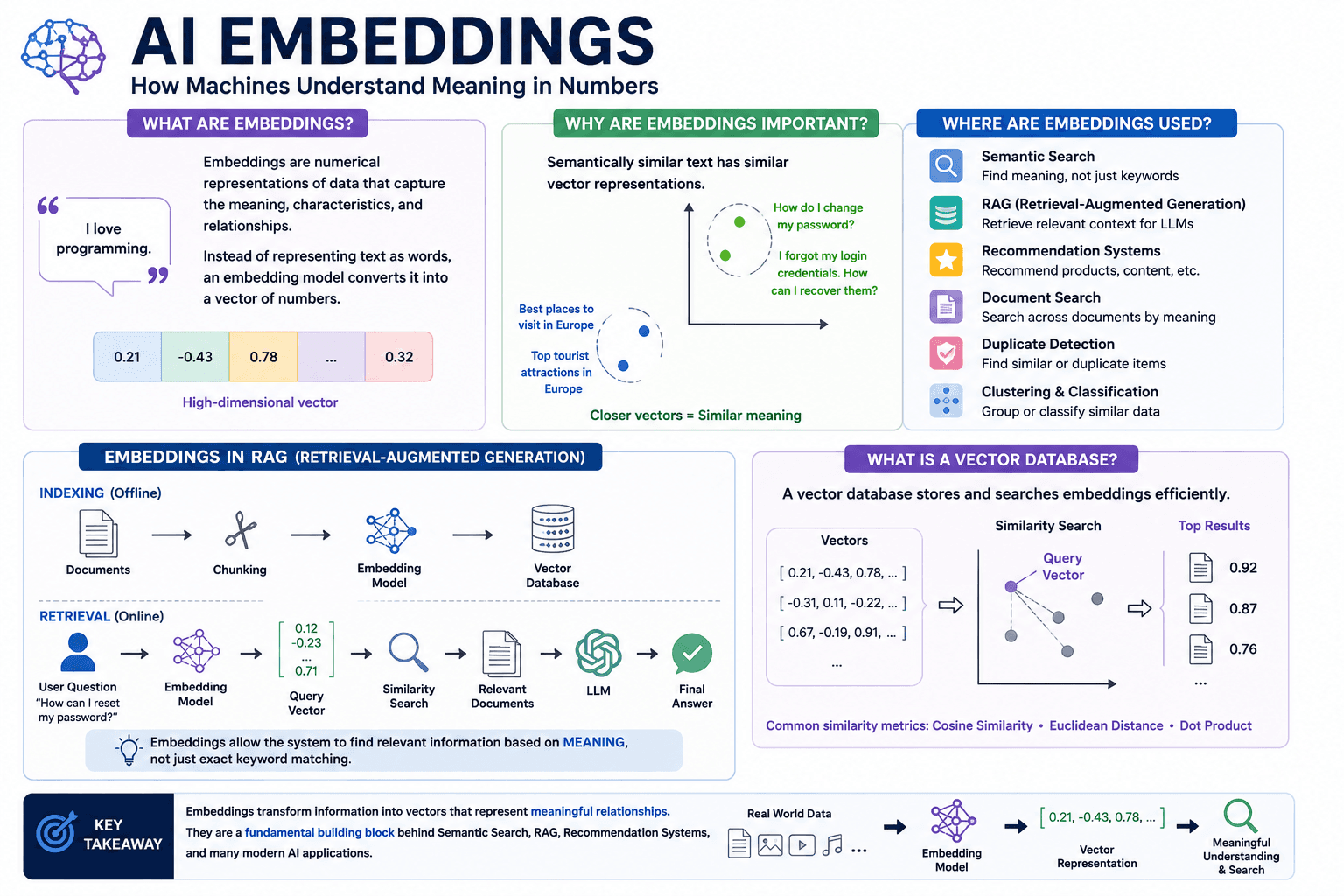
Documents → Embeddings → Vector Database → Retrieval → Relevant Context → LLM → Answer
The model does not need to memorize the information. Instead, relevant information is retrieved and provided to the model when needed.
What Is Fine-Tuning?
Fine-Tuning means further training a pre-trained model on a specialized dataset to modify its behavior or improve performance on a specific task.
For example, a company may fine-tune a model to consistently follow a particular response style or perform a specialized classification task.
Key Differences
RAG | Fine-Tuning |
|---|---|
Adds external knowledge at runtime | Changes model behavior through training |
Does not modify model parameters | Updates model parameters |
Excellent for changing information | Better for consistent specialized behavior |
Uses retrieval | Uses additional training |
Easier to update knowledge | Updating knowledge requires new training |
Can provide source documents | Doesn't inherently provide sources |
When Should You Use RAG?
RAG is usually a strong choice when:
Your knowledge changes frequently
You need private company documents
You want answers grounded in specific sources
You need citations or traceability
You don't want to retrain the model whenever information changes
Example:
A company's HR chatbot needs to answer questions using the latest employee policies.
RAG is usually more appropriate.
When Should You Use Fine-Tuning?
Fine-Tuning can be useful when you need:
Consistent output style
Specialized task behavior
Domain-specific patterns
Better performance on a well-defined task
The model to follow a particular behavior more consistently
Can You Use Both?
Yes.
In some production systems, RAG and Fine-Tuning can complement each other.
For example:
Fine-Tuning → teaches the model how to behave
RAG → provides the model with what it needs to know
This combination can be powerful when designed appropriately.
Interview Tip
A common misconception is:
“RAG adds knowledge to the model permanently.”
Not exactly.
RAG provides relevant information to the model during inference. The model's underlying parameters are not updated.
Key Takeaway
RAG helps an LLM access external knowledge.
Fine-Tuning changes the model's learned behavior.
A good AI Engineer doesn't simply ask “Which technology is better?”
They ask:
“What problem am I trying to solve?”
That is the key to choosing between RAG, Fine-Tuning, Prompt Engineering—or a combination of them.
Related articles
More in AI Fundamentals
Comments
Sign in to join the discussion.