What Is AI Hallucination? Why Does It Happen and How Can We Reduce It?
AI hallucination occurs when an AI model generates information that sounds convincing but is incorrect, unsupported, or fabricated. Learn why hallucinations happen and how production AI systems can reduce them.
What Is AI Hallucination?
One of the most important challenges in Generative AI is hallucination.
What Is Hallucination?
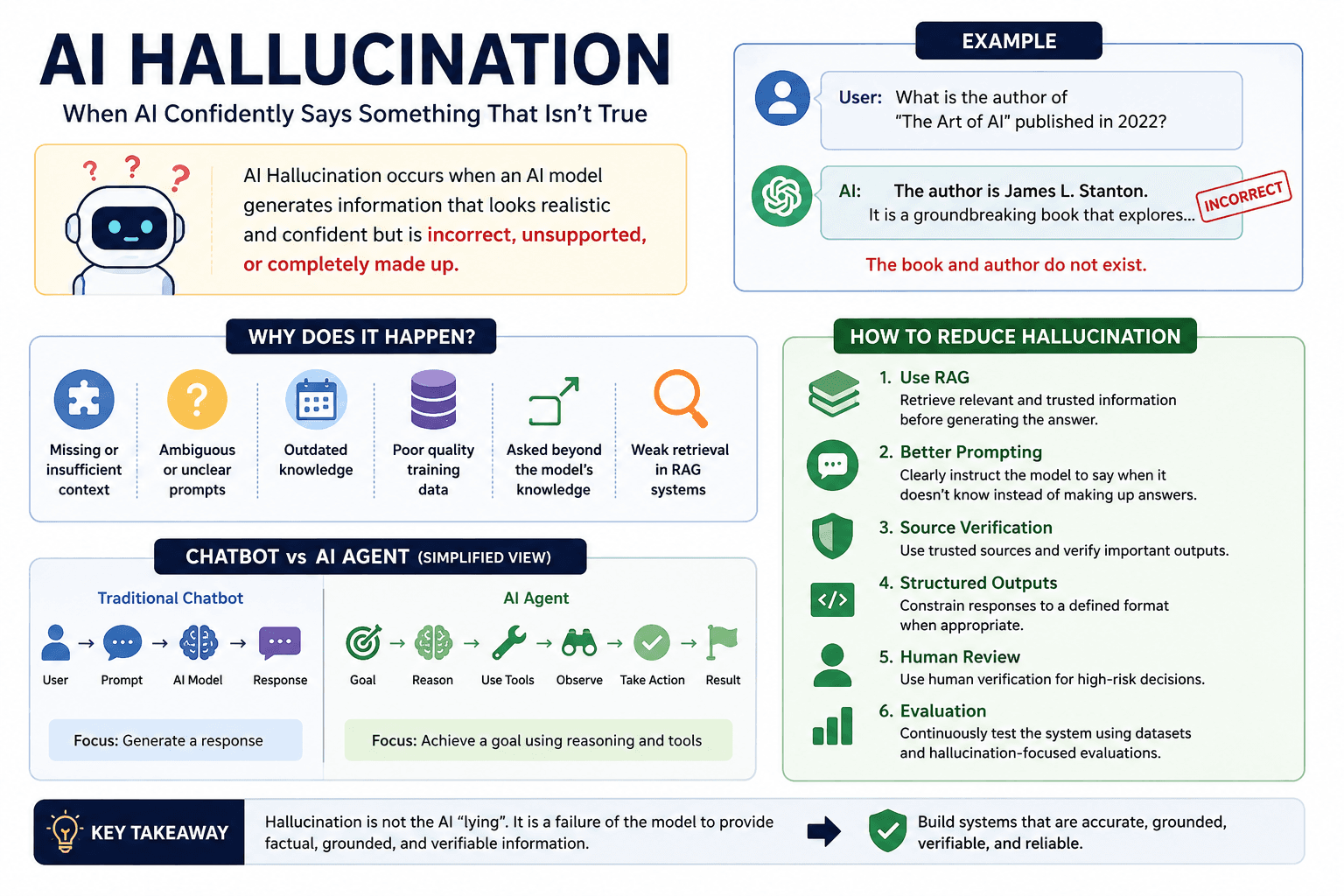
An AI hallucination occurs when an AI model generates an answer that appears confident and plausible but is factually incorrect, unsupported, or fabricated.
For example, an LLM might provide a fake research paper, invent a non-existent API, or give an incorrect fact while presenting it confidently.
Why Does Hallucination Happen?
LLMs generate responses by predicting likely tokens based on learned patterns. They don't automatically verify every statement against a reliable source.
Common causes include:
Missing or insufficient context
Ambiguous prompts
Outdated knowledge
Poor-quality training data
Asking the model to answer beyond its available information
Weak retrieval in RAG systems
How Can We Reduce Hallucinations?
A production AI system can use several techniques:
1. RAG
Retrieve relevant and trusted information before generating the answer.
2. Better Prompting
Clearly instruct the model to say when it doesn't know instead of inventing information.
3. Source Verification
Use trusted sources and validate important outputs.
4. Structured Outputs
Constrain responses to a defined format when appropriate.
5. Human Review
Use human verification for high-risk decisions.
6. Evaluation
Continuously test the system using representative datasets and hallucination-focused evaluations.
Interview Tip
Don't say:
"Hallucination happens because the AI doesn't know the answer."
That's incomplete.
A model can generate a plausible answer even when it lacks sufficient evidence because its fundamental task is generating likely text, not guaranteeing factual truth.
Key Takeaway
AI hallucination is not simply a model “lying.” It is a failure where generated content is presented without adequate factual grounding.
As an AI Engineer, the goal is not just to build a model that generates fluent answers, but to build a system that produces accurate, grounded, verifiable, and reliable results.
Related articles
More in AI Fundamentals
Comments
Sign in to join the discussion.