What Is Similarity Search? How Does Cosine Similarity Work in AI?
Similarity Search helps AI systems find information that is semantically similar to a query. Learn how embeddings, vector databases, and Cosine Similarity work together in modern AI applications.
What Is Similarity Search?
Similarity Search is a technique used to find data that is most similar to a given query based on its vector representation.
Unlike traditional keyword search, it can find information based on meaning and semantic relationships.
For example:
Query: "How can I recover my forgotten password?"
A similarity search may find:
"Steps to reset your account credentials."
Even though the exact words are different, the meaning is similar.
How Does It Work?
A typical AI similarity-search workflow is:
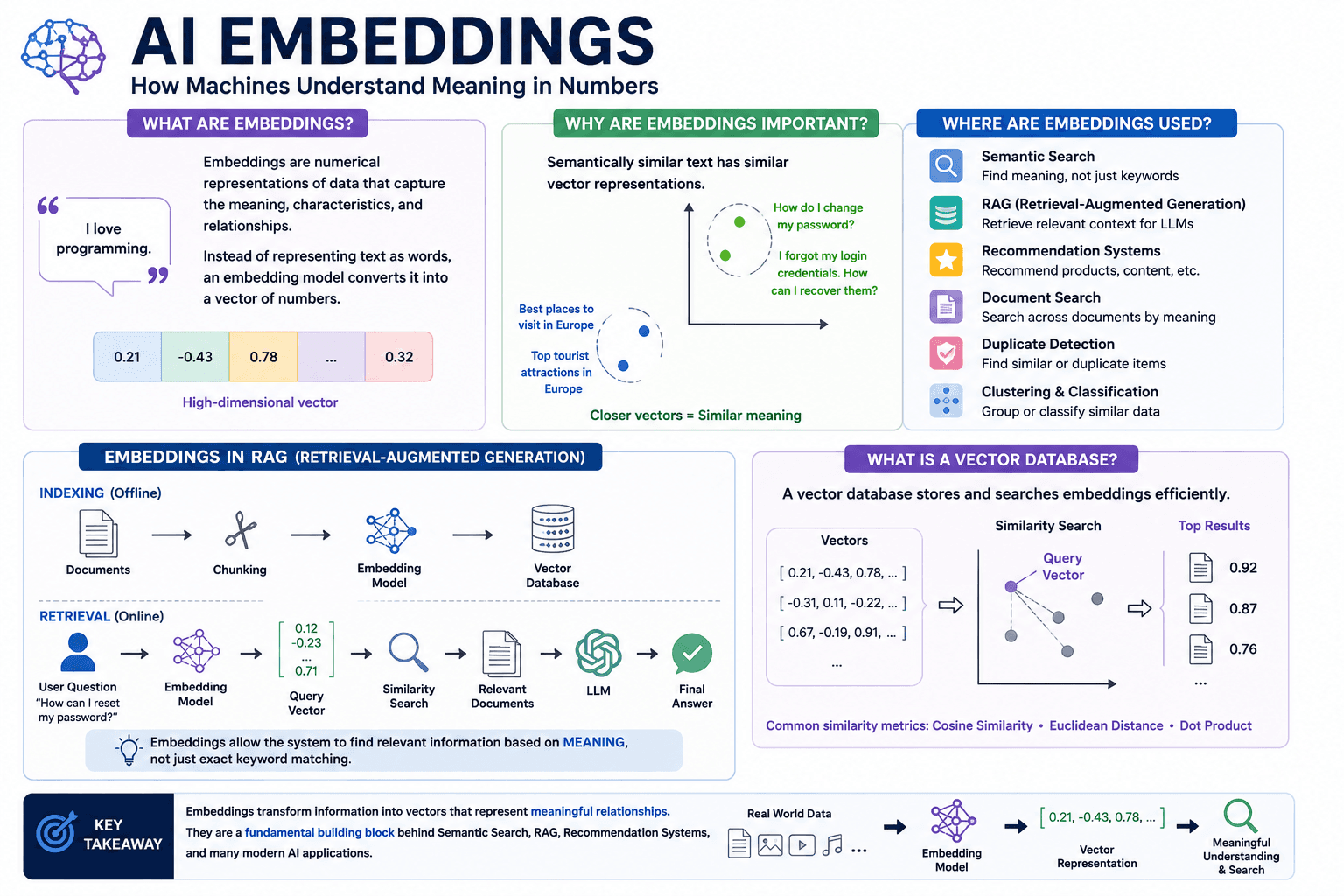
Text → Embedding Model → Vector → Similarity Calculation → Top Relevant Results
For a RAG system:
User Query → Query Embedding → Vector Database → Similarity Search → Relevant Documents → LLM
What Is Cosine Similarity?
Cosine Similarity measures how similar two vectors are by calculating the cosine of the angle between them.
Its value generally ranges from:
-1 → Completely opposite
0 → Unrelated/orthogonal
1 → Highly similar
For many text-embedding applications, vectors pointing in a similar direction indicate similar semantic meaning.
Simple Example
Imagine these two sentences:
A: "I want to learn Python."
B: "I want to study Python programming."
Their embeddings would likely be close in vector space.
Therefore, their Cosine Similarity would likely be high.
But:
C: "The weather is very cold today."
would likely have a much lower similarity with A.
Why Is It Important?
Similarity Search is widely used in:
RAG systems
Semantic Search
Recommendation Systems
Document Retrieval
Image Search
Duplicate Detection
Question Answering
Interview Tip
Don't say:
"Cosine Similarity compares two pieces of text directly."
More accurately:
"Cosine Similarity compares vector representations, such as embeddings, to measure how similar their direction is in vector space."
The text is first converted into embeddings; then the vectors are compared.
Key Takeaway
Similarity Search finds the most relevant information based on vector similarity rather than exact keyword matching.
Embeddings represent the data.
Vector databases store and retrieve the vectors.
Similarity metrics determine how closely the vectors are related.
Together, these components form a core foundation of modern RAG and semantic search systems.
Related articles
More in AI Fundamentals
Comments
Sign in to join the discussion.