Why Do LLMs Hallucinate? Understanding AI Hallucinations
AI hallucination occurs when an LLM generates information that sounds convincing but is incorrect or fabricated. Learn why hallucinations happen and how AI engineers can reduce them.
Why Do LLMs Hallucinate?
One of the most important questions in Generative AI interviews is:
Why does an AI model sometimes generate information that sounds correct but is actually wrong?
The answer is AI hallucination.
What Is AI Hallucination?
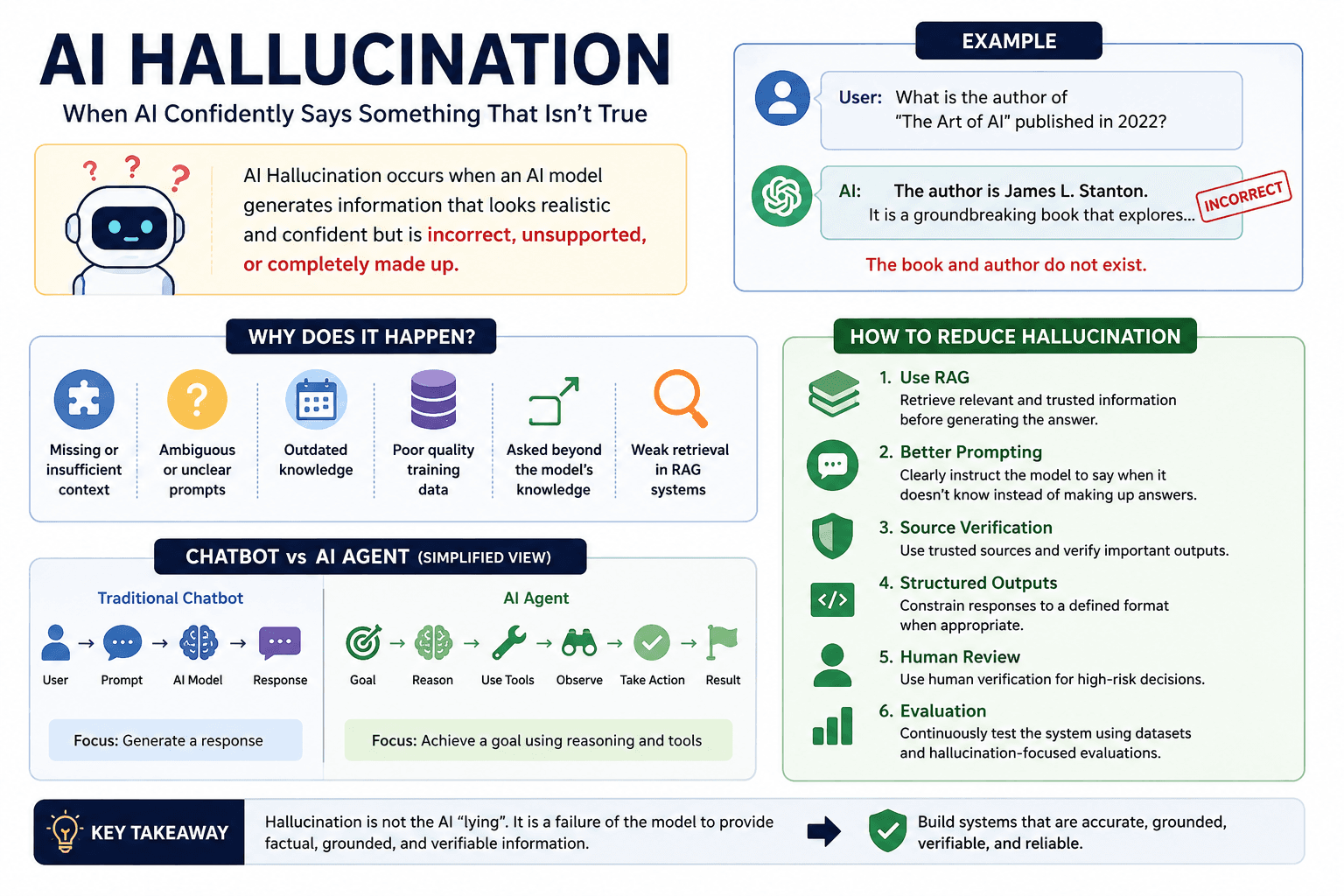
An AI hallucination occurs when a Large Language Model (LLM) generates information that is incorrect, misleading, or completely fabricated, while presenting it as if it were true.
The response may sound confident and logical, even though the information is wrong.
Why Does It Happen?
LLMs are primarily designed to predict the next likely token based on patterns learned during training.
They are not automatically fact-checking every statement they generate.
Hallucinations can happen because:
The model has insufficient knowledge about the topic.
The prompt is unclear or ambiguous.
The required information is missing from the available context.
The model generates a plausible response instead of saying, “I don't know.”
The information may be outdated or incomplete.
Real-World Example
Imagine asking:
Who won the 2030 FIFA World Cup?
If reliable information about the event is unavailable, an LLM might still generate a confident answer.
That incorrect answer would be considered a hallucination.
How Can We Reduce Hallucinations?
AI engineers can use several techniques:
✅ RAG (Retrieval-Augmented Generation)
Provide the model with relevant information from trusted sources.
✅ Clear Prompts
Give the model precise instructions and sufficient context.
✅ Grounding
Connect the AI system to reliable documents, databases, or knowledge sources.
✅ Validation
Verify important AI-generated information before using it.
Interview Tip
A common misconception is:
Hallucination means the AI model is broken.
Not necessarily.
Hallucination is a known limitation of probabilistic language models. LLMs generate the most likely sequence of tokens based on learned patterns; they do not inherently guarantee that every generated statement is factually correct.
Key Takeaway
LLMs are designed to generate plausible language, not guaranteed truth.
As AI Engineers, our responsibility is to design systems that ground, validate, and verify AI outputs, especially when accuracy is critical.
Understanding hallucination is essential when building reliable production-grade AI applications.
Related articles
More in AI Fundamentals
Comments
Sign in to join the discussion.