What Is a Vector Database? How Does It Work in AI?
Vector databases store and search numerical embeddings efficiently, making them essential for RAG, semantic search, recommendation systems, and modern AI applications.
What Is a Vector Database?
If you are working with RAG, embeddings, semantic search, or AI applications, you will often hear the term Vector Database.
But what exactly is it?
What Is a Vector Database?
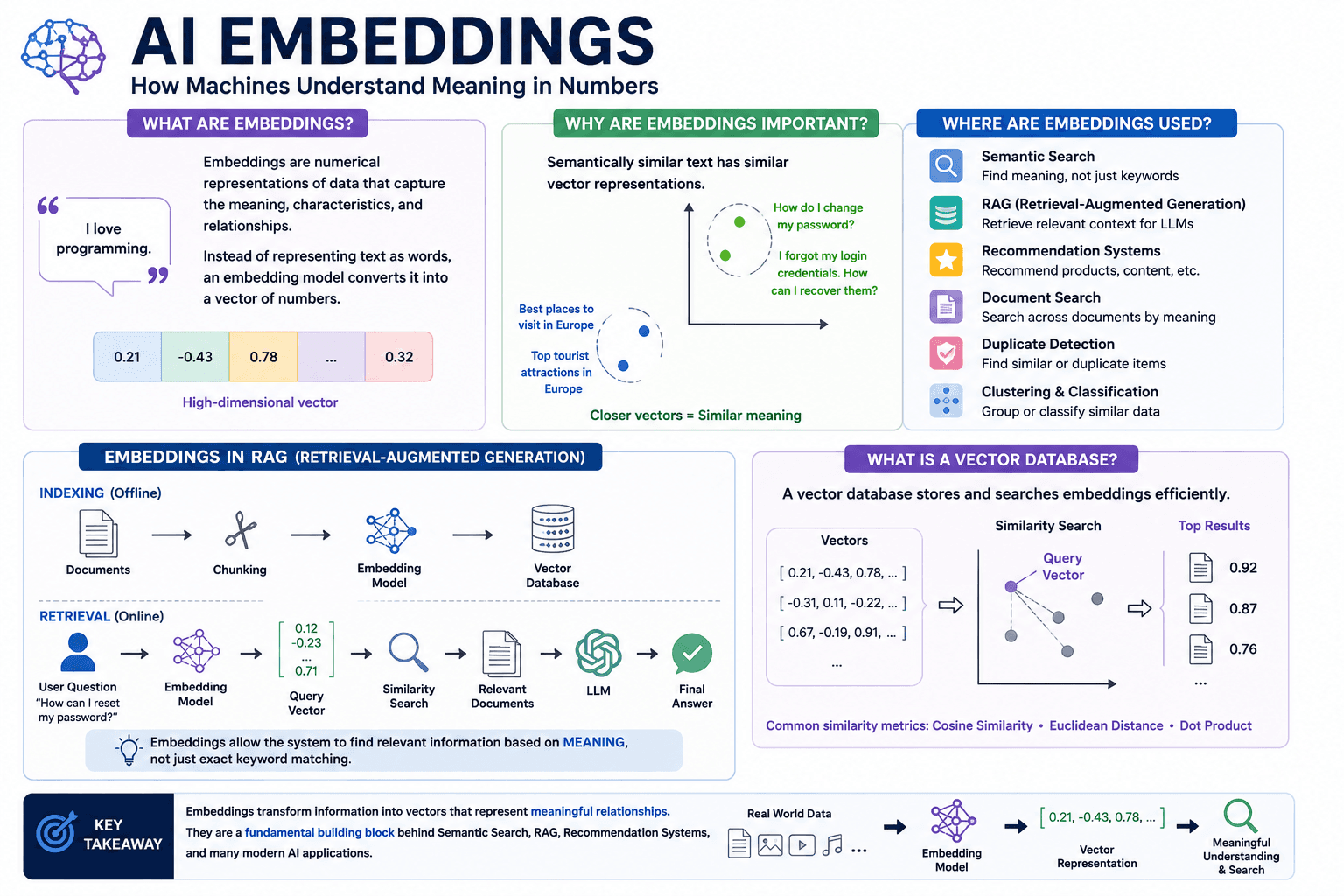
A Vector Database is a specialized database designed to store, index, and search vector embeddings efficiently.
These vectors represent the meaning or characteristics of data such as:
Text
Images
Audio
Documents
Instead of searching only for exact keywords, a vector database can find information based on semantic similarity.
How Does It Work?
A typical workflow looks like this:
1. Create Embeddings
Documents or other data are converted into numerical vectors using an embedding model.
2. Store Vectors
The vectors and relevant metadata are stored in a vector database.
3. Convert the Query
When a user asks a question, the query is also converted into a vector.
4. Similarity Search
The database compares the query vector with stored vectors and finds the most similar ones.
5. Return Relevant Information
The retrieved information can then be provided to an LLM to generate the final response.
Example
Imagine your company has thousands of internal documents.
A user asks:
"What is our employee leave policy?"
A traditional keyword search might struggle if the document uses different wording.
A vector database can identify documents with similar meaning, such as:
"Annual vacation and employee absence guidelines."
This makes semantic search much more powerful.
Vector Database in RAG
Vector databases are commonly used in RAG (Retrieval-Augmented Generation).
The workflow can look like:
Documents → Chunks → Embeddings → Vector Database → Similarity Search → Relevant Context → LLM → Answer
This allows an LLM to access relevant external knowledge without retraining the model.
Popular Vector Databases
Some commonly used vector database technologies include:
Pinecone
Weaviate
Milvus
Qdrant
Chroma
pgvector for PostgreSQL
Interview Tip
A common misconception is:
"A vector database is just another normal database."
Not exactly.
Traditional databases are primarily optimized for structured data and exact or rule-based queries.
Vector databases are specifically optimized for high-dimensional vector similarity search.
Many modern systems also combine vector search with traditional filtering and metadata queries.
Key Takeaway
A Vector Database stores and searches embeddings based on similarity rather than relying only on exact keyword matching.
It is one of the core components behind RAG, semantic search, recommendation systems, and many modern AI applications.
Related articles
More in AI Fundamentals
Comments
Sign in to join the discussion.