What Are Embeddings in AI? How Do They Work?
Embeddings convert text, images, and other data into numerical vectors that capture meaning and relationships. Learn how embeddings work and why they are essential for RAG, semantic search, and recommendation systems.
What Are Embeddings?
If you're working with RAG, Vector Databases, Semantic Search, or modern AI applications, understanding embeddings is essential.
But what exactly is an embedding?
What Are Embeddings?
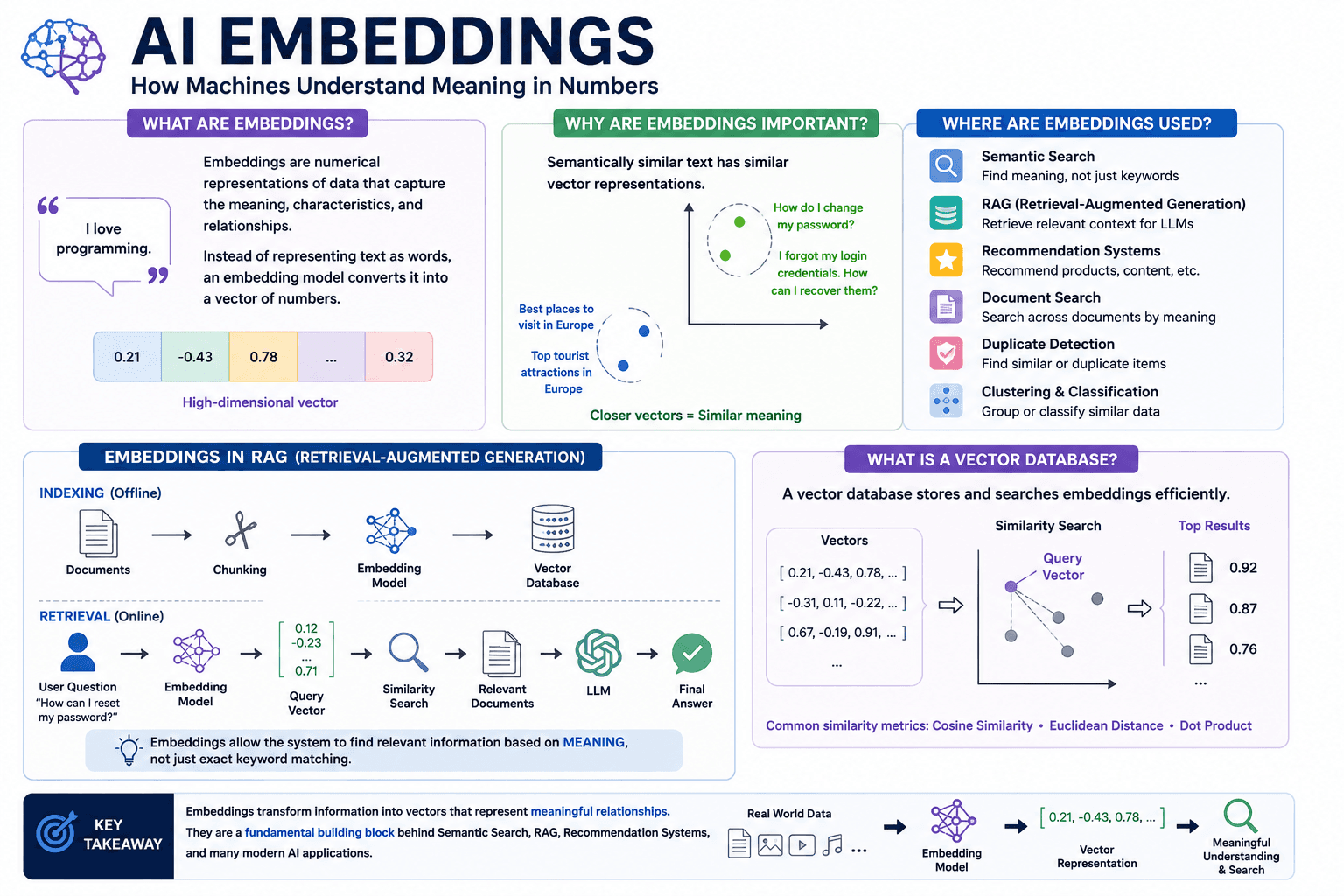
An embedding is a numerical representation of data—such as text, images, or audio—that captures its meaning, characteristics, and relationships.
For text, an AI model converts words, sentences, or documents into a vector—a list of numbers.
In simple terms:
Embeddings convert human-understandable information into a mathematical representation that AI systems can compare and process.
Why Are Embeddings Important?
Embeddings allow AI systems to understand semantic similarity, rather than relying only on exact keyword matching.
For example:
Query: “How can I reset my password?”
A document containing:
“Steps to recover your account credentials.”
may still be considered highly relevant because the two texts convey similar meanings, even though they use different words.
This is called semantic search.
How Do Embeddings Work?
A typical embedding workflow looks like this:
1. Input Data
Text, images, audio, or other data is provided to an embedding model.
2. Vector Generation
The model converts the input into a numerical vector.
3. Store the Vector
The vector can be stored in a vector database.
4. Similarity Search
When a user sends a query, it is also converted into a vector.
The system then compares vectors using similarity measures such as cosine similarity to find the most relevant information.
Where Are Embeddings Used?
Embeddings are widely used in:
RAG systems
Semantic Search
Vector Databases
Recommendation Systems
Document Retrieval
Question Answering
Similarity Detection
Content Matching
Embeddings in RAG
Embeddings play a critical role in RAG (Retrieval-Augmented Generation).
A typical RAG system can:
Documents → Chunks → Embeddings → Vector Database → Similarity Search → Relevant Context → LLM → Answer
This allows an AI system to retrieve information based on meaning, rather than simply matching exact words.
Interview Tip
A common misconception is:
“Embeddings store the original document.”
That's not quite correct.
An embedding is a numerical representation of the input, not a replacement for the original document.
The original content is usually stored separately, while the embedding helps the system find relevant content efficiently.
Key Takeaway
Embeddings transform data into numerical vectors that capture meaningful relationships.
They are one of the core technologies behind RAG, semantic search, vector databases, and many modern AI applications.
If you're preparing for an AI Engineer interview, understanding embeddings is fundamental.
Related articles
More in AI Fundamentals
Comments
Sign in to join the discussion.