What Is a Large Language Model (LLM)?
A Large Language Model (LLM) is an AI model trained on large amounts of text to understand and generate human-like language. Learn what LLMs are, how they work, how they are trained, and where they are used, with simple, real-world examples.
You have probably heard terms like ChatGPT, Gemini, Claude, and Llama. Many of these modern AI applications are powered by a technology called a Large Language Model, or LLM.
But what exactly is an LLM?
What Is an LLM?
LLM stands for Large Language Model.
An LLM is a type of AI model designed to process, understand patterns in, and generate human language.
It can perform tasks such as:
Answering questions
Writing articles
Summarizing text
Translating languages
Generating code
Explaining technical concepts
Extracting information
Having conversations
For example, when you ask ChatGPT:
"Explain Machine Learning to a beginner."
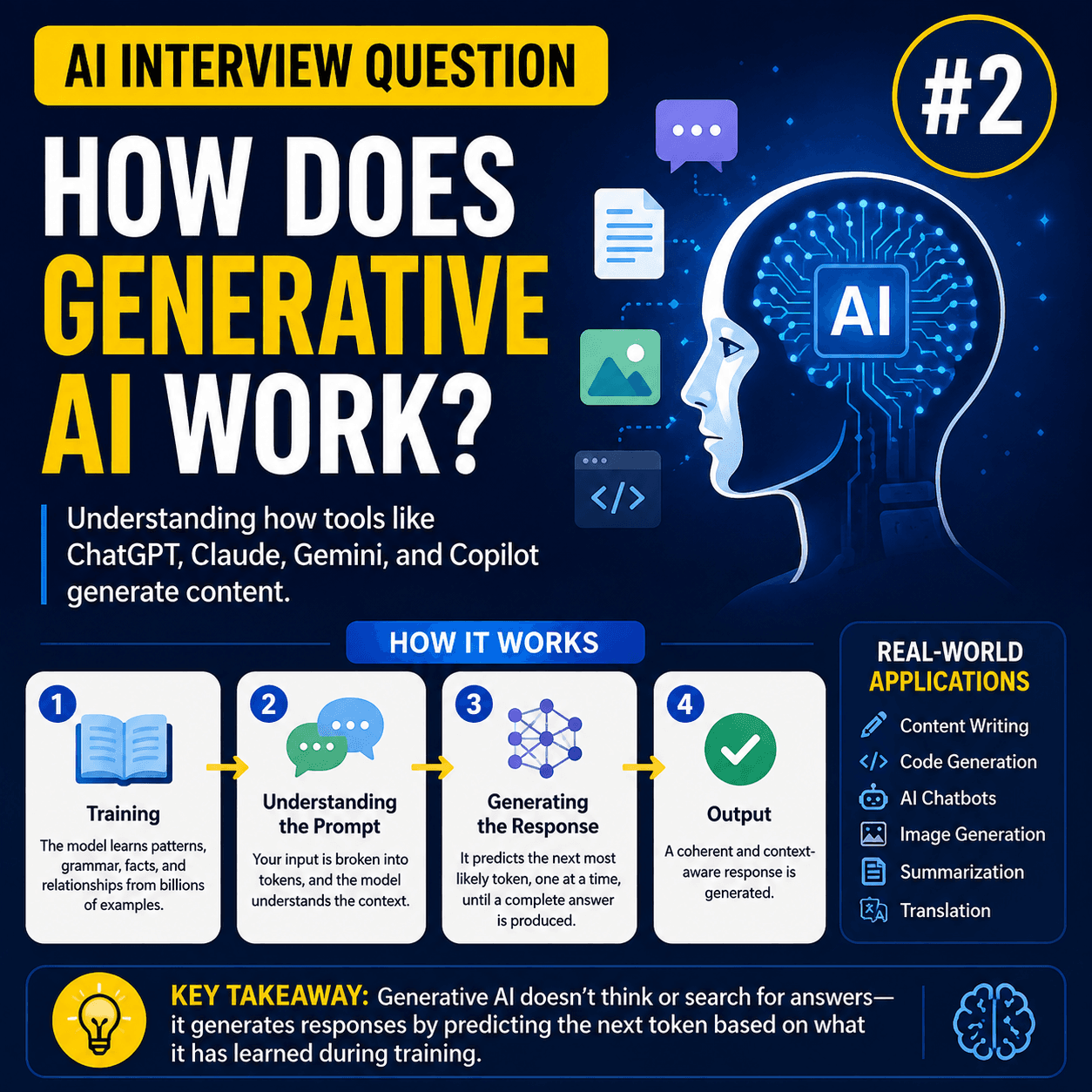
An underlying language model processes your prompt and generates a response based on patterns it learned during training.
Why Is It Called "Large"?
The word Large refers to several aspects of the model.
First, LLMs are typically trained using very large amounts of data.
Second, modern LLMs can contain a very large number of parameters.
A parameter is a learned numerical value inside the model that helps it represent patterns and relationships in data.
Modern language models can contain millions, billions, or even hundreds of billions of parameters, depending on the model and architecture.
The exact architecture, training data, and size vary between models.
What Does "Language Model" Mean?
A language model is a model that learns patterns in language and can estimate what tokens are likely to come next in a sequence.
For example:
"The sun rises in the..."
A language model may assign high probability to:
east
The model can use the context of previous tokens to predict what should come next.
Modern LLMs do much more than simple word prediction, but next-token prediction is a fundamental part of how many autoregressive language models generate text.
How Does an LLM Learn?
Before an LLM can answer questions, it needs to be trained.
During training, the model processes huge amounts of text and learns patterns between tokens.
For example, it may learn relationships between:
Programming → code → functions → variables
or:
Bangladesh → Dhaka → capital
The model builds internal representations that allow it to work with language and concepts.
Step 1: Text Is Converted into Tokens
LLMs do not directly process text exactly as humans see it.
Text is divided into smaller pieces called tokens.
A token might represent:
A complete word
Part of a word
Punctuation
A symbol
For example, a sentence may be broken into several tokens before being processed by the model.
Step 2: Tokens Are Converted into Numerical Representations
Computers work with numbers.
The tokens are therefore converted into numerical representations that the neural network can process.
These representations help the model work with relationships between different pieces of language.
This is one reason concepts such as embeddings are important in modern AI.
Step 3: The Transformer Processes the Input
Most modern LLMs are based on the Transformer architecture or architectures derived from it.
Transformers use mechanisms such as attention to determine how different tokens relate to each other.
For example, consider:
"The developer opened the laptop because it was slow."
The model needs to understand the relationship between words and the surrounding context to generate a sensible continuation.
Attention helps the model consider relevant parts of the input when processing a token.
Step 4: The Model Predicts the Next Token
After processing the input, the model calculates probabilities for possible next tokens.
For example:
"I am learning..."
Possible next tokens might include:
programming
Python
AI
English
The model selects a token according to its probability distribution and the generation settings.
Then it predicts the next token again.
This process continues until the response is complete.
Pre-Training and Fine-Tuning
Modern LLM development often involves multiple stages.
Pre-Training
During pre-training, the model learns general patterns from a very large corpus of data.
This stage helps the model develop broad language and knowledge representations.
Fine-Tuning or Post-Training
After pre-training, a model may be further trained or optimized to improve its usefulness for specific tasks.
This can help with:
Instruction following
Conversation
Safety behavior
Specific domains
Tool use
Better response formatting
So, an LLM does not become a useful assistant only through its initial training. Additional post-training processes can significantly shape how it behaves.
Is an LLM a Search Engine?
No.
A search engine primarily retrieves and ranks information from indexed sources.
An LLM generates output using its learned model representations and the context provided to it.
That said, an AI application can combine an LLM with search or retrieval systems. This is common in Retrieval-Augmented Generation (RAG) systems.
For example:
Search/Database → Relevant information → LLM → Final answer
This allows an application to provide an LLM with external information before generating a response.
Is an LLM a Database?
No.
An LLM is not simply a database containing a copy of every document it was trained on.
Instead, training adjusts the model's parameters so that it learns statistical patterns and representations.
This distinction is important because an LLM can generate text that was not explicitly present as a complete sentence in its training data.
However, models can sometimes memorize specific information, so the distinction between "learning" and "memorization" is not always perfectly simple.
What Can LLMs Do?
LLMs are useful for many applications.
Content Generation
They can create:
Blog posts
Emails
Product descriptions
Summaries
Social media content
Programming
They can help with:
Code generation
Debugging
Refactoring
Documentation
Test generation
SQL queries
Language Tasks
They can perform:
Translation
Summarization
Classification
Question answering
Information extraction
Conversational Applications
LLMs can power:
Customer support assistants
AI tutors
Internal company assistants
Coding assistants
Knowledge assistants
A Simple Real-World Example
Imagine hiring a very fast virtual assistant who has been trained on a huge amount of language data.
You ask:
"Write a professional email requesting a meeting."
The assistant uses its learned understanding of language, context, and writing patterns to generate an appropriate email.
Now you say:
"Make it shorter and more polite."
The model processes the new instruction together with the conversation context and generates a revised response.
This is a simple way to understand what an LLM-powered assistant does.
What Are the Limitations of LLMs?
Although LLMs are powerful, they are not perfect.
They can:
Generate incorrect information
Hallucinate facts
Misunderstand ambiguous prompts
Produce outdated information
Reflect biases present in their training or evaluation environment
Struggle with some complex reasoning tasks
Have context-length limitations
For important decisions, LLM outputs should therefore be verified.
LLM vs Traditional Software
Traditional software typically follows explicitly programmed rules.
For example:
Input → Rule → Output
An LLM works differently.
A simplified representation is:
Input → Neural Network → Probability Distribution → Generated Output
The exact internal computation is much more complex, but this comparison helps explain the difference.
A Simple Analogy
Think of an LLM like an extremely sophisticated language engine.
It has learned patterns from a huge amount of language data.
When you give it a prompt, it uses those learned patterns and the current context to generate a response.
It does not think exactly like a human and should not automatically be assumed to have human understanding or real-world awareness.
Final Takeaway
A Large Language Model (LLM) is an AI model designed to process and generate human language.
A simplified process looks like this:
Training Data → Tokenization → Neural Network Training → Learned Parameters → User Prompt → Context Processing → Next-Token Prediction → Generated Response
LLMs are behind many modern AI applications and are a fundamental technology for understanding Generative AI.
Once you understand LLMs, concepts such as Transformers, tokens, context windows, temperature, embeddings, RAG, fine-tuning, and AI agents become much easier to understand.
Related articles
More in Artificial Intelligence
Comments
Sign in to join the discussion.