How Does Generative AI Actually Generate Content?
Generative AI can create text, images, audio, video, and code from simple instructions. But how does it actually generate this content? This guide explains the basic process of Generative AI in simple language with practical examples.
Generative AI has become one of the most important areas of modern Artificial Intelligence. Tools such as ChatGPT, image generators, coding assistants, and AI video tools can create new content from a simple user instruction.
But an important question is:
How does Generative AI actually create something that did not exist before?
The answer becomes easier to understand when we look at how these models are trained and how they generate output.
What is Generative AI?
Generative AI is a type of Artificial Intelligence designed to create new content.
The content can include:
Text
Images
Audio
Video
Code
Music
For example, when you ask ChatGPT:
"Write a blog post about Machine Learning."
The system does not simply search the internet and copy an existing article. A generative model uses patterns learned during training to generate a new response.
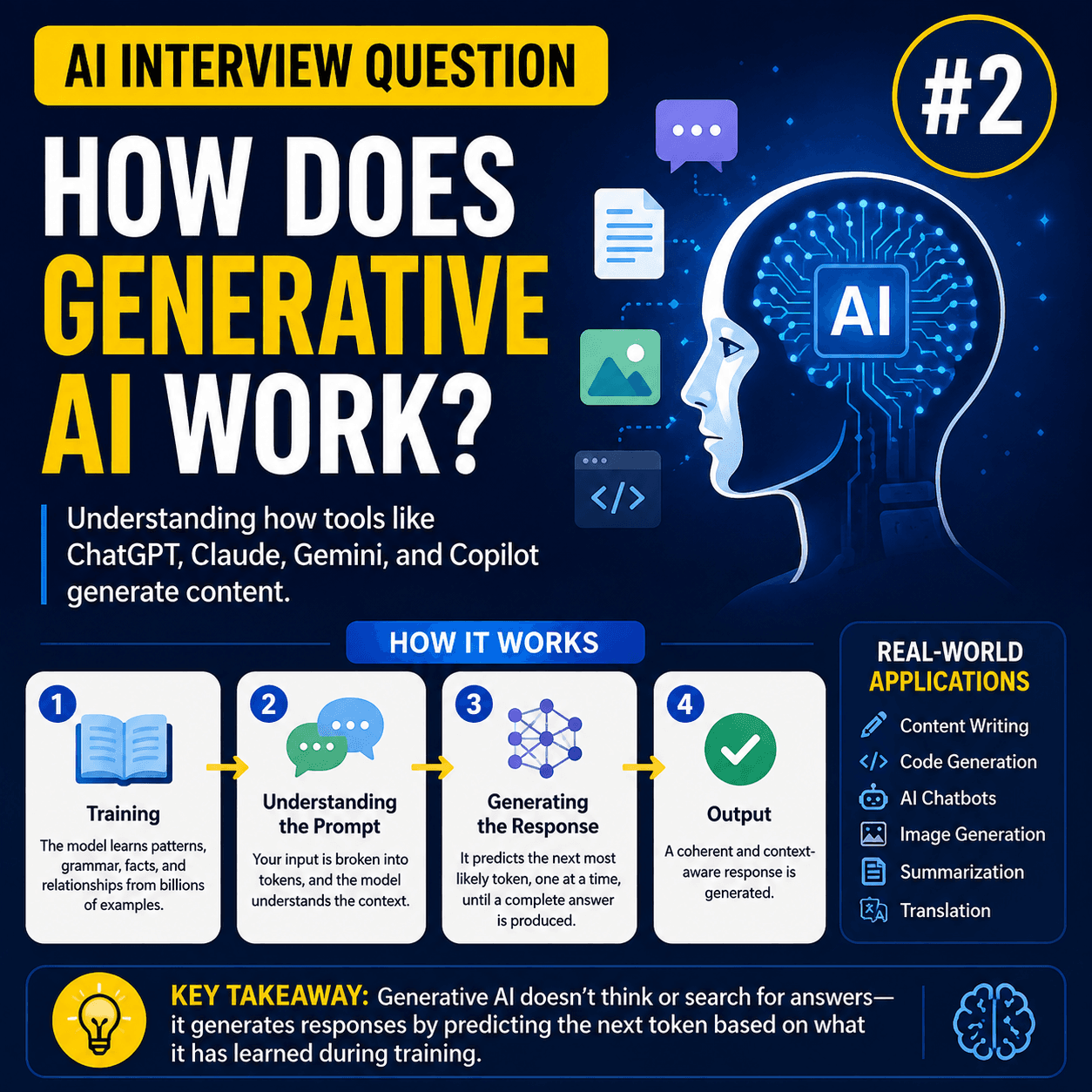
Step 1: The Model Learns from Large Amounts of Data
Before a Generative AI model can create content, it needs to be trained.
During training, the model processes a huge amount of data.
For a language model, this may include text from many different sources.
The model does not simply memorize everything like a database. Instead, it learns statistical patterns and relationships between words, phrases, concepts, and other pieces of information.
For example, the model may learn that:
"Bangladesh is the capital of..." is unlikely because Dhaka is the capital of Bangladesh.
Through enormous numbers of examples, the model becomes better at understanding language patterns.
Step 2: The Input Is Converted into Tokens
When you type a prompt, the model does not process it exactly the way a human reads a sentence.
The text is broken into smaller units called tokens.
For example:
"Artificial Intelligence is powerful"
may be represented internally as several tokens.
Tokens can be complete words, parts of words, punctuation marks, or other pieces of text.
The model works with these tokens rather than directly working with human-readable sentences.
Step 3: The Model Understands Relationships
Modern Generative AI models use neural network architectures such as the Transformer.
Transformers are designed to understand relationships between different parts of the input.
For example, in the sentence:
"The developer gave the laptop to the designer because she needed it."
Understanding who "she" refers to requires looking at the relationship between different words in the sentence.
The model processes these relationships using mechanisms such as attention.
Step 4: The Model Predicts What Comes Next
This is one of the most important ideas behind language generation.
A language model can predict the next likely token based on the tokens that came before it.
For example:
"I am going to the..."
The model might assign high probability to words such as:
"office", "market", or "school", depending on the context.
The model then selects a token according to its generation process.
After that, it predicts the next token again.
This process continues repeatedly.
For example:
I → am → going → to → the → office
Eventually, a complete response is generated.
Does the AI Write the Whole Answer at Once?
Usually, no.
A language model typically generates the response incrementally, token by token.
Imagine asking:
"Explain Machine Learning in simple language."
The model may generate something conceptually similar to:
"Machine"
then:
"Learning"
then:
"is"
then:
"a"
then:
"method"
and so on.
The actual internal process is much more complex, but the basic idea is predicting and generating tokens sequentially.
What About Images?
Generative AI can also create images, but image generation works differently from text generation.
Modern image-generation systems learn patterns from large collections of images and associated information.
Many image-generation approaches gradually transform random noise into an image that matches the requested description.
For example, when you request:
"A futuristic city at night with flying cars."
The system uses learned patterns about concepts such as:
City
Night
Buildings
Cars
Flying
Lighting
and generates an image that combines these concepts.
What About AI-Generated Music or Video?
The same broad idea applies to other forms of Generative AI.
The model learns patterns from training data and then generates new outputs based on an input or prompt.
For example:
Text → language model
Image → image generation model
Audio → audio generation model
Video → video generation model
Code → coding model
Each type uses different architectures and techniques, but the fundamental idea is learning patterns and using them to generate new content.
Is Generative AI Just Copying Training Data?
Not necessarily.
A well-trained generative model learns statistical representations and patterns from its training data and uses those learned representations to produce outputs.
However, models can sometimes reproduce memorized information, especially for frequently repeated or distinctive material.
This is one reason why copyright, privacy, memorization, and data provenance are important issues in Generative AI.
Why Can Generative AI Make Mistakes?
Generative AI does not automatically know that every generated statement is true.
A language model is primarily optimized to generate plausible sequences based on learned patterns.
Because of this, it can sometimes produce incorrect information with high confidence.
These incorrect outputs are often called hallucinations.
For example, a model might provide a realistic-looking but completely incorrect reference or historical detail.
That is why important information should be verified rather than blindly trusted.
A Simple Analogy
Imagine you have a writer who has read millions of books and articles.
The writer has learned:
How sentences are structured
Which words commonly appear together
How topics are explained
How different writing styles work
Now you ask the writer to create an article about AI.
The writer uses what they learned to produce a new article.
Generative AI works in a similar high-level way, although the underlying technology is mathematical and based on neural networks rather than human understanding.
Simple Generation Flow
You can remember the process like this:
Training Data → Model Training → Learned Patterns → User Prompt → Token Processing → Prediction → Generated Output
For a chatbot, this might look like:
Your question → Tokens → Transformer model → Next-token prediction → More predictions → Final answer
Final Takeaway
Generative AI creates new content by using patterns learned from large amounts of training data.
For text generation, a simplified process is:
Your prompt is converted into tokens.
The model processes relationships between those tokens.
The model predicts the next likely token.
It repeats this process many times.
The generated tokens are converted back into readable text.
The model is not simply copying and pasting an answer. It is using learned patterns to generate an output that fits the context of your request.
Understanding this basic process makes many other AI concepts—such as LLMs, Transformers, tokens, embeddings, prompting, and hallucinations—much easier to understand.
Related articles
More in Artificial Intelligence
Comments
Sign in to join the discussion.