What Is a Vector Database? Why Is It Important for RAG?
A Vector Database stores and searches numerical embeddings based on semantic similarity. Learn how vector databases power RAG systems and modern AI applications.
What Is a Vector Database?
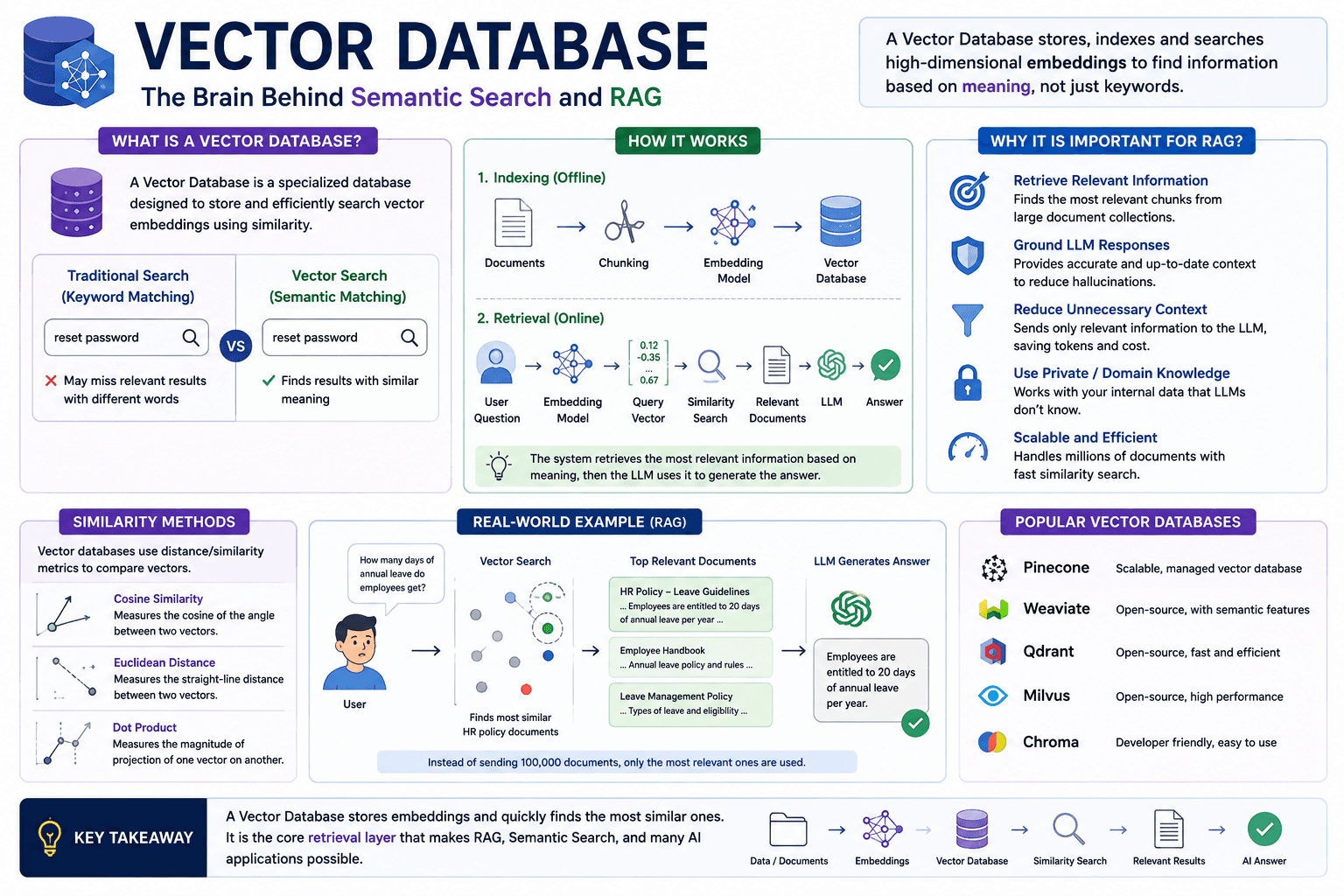
A Vector Database is a database designed to store, index, and efficiently search vector embeddings.
Instead of searching only for exact keywords, it can find information based on semantic similarity or meaning.
For example:
"How can I reset my password?"
can retrieve a document containing:
"Steps to recover your forgotten login credentials."
Even though the exact words are different, their meanings are similar.
How Does It Work?
A typical workflow is:
Document → Chunking → Embedding → Vector Database
When a user asks a question:
Question → Embedding → Similarity Search → Relevant Documents → LLM → Answer
The vector database searches for vectors that are most similar to the user's query.
Why Is It Important for RAG?
In a RAG (Retrieval-Augmented Generation) system, the vector database acts as the searchable knowledge layer.
It helps the system:
Retrieve relevant information
Search large document collections
Ground LLM responses
Reduce unnecessary context
Work with private or domain-specific knowledge
Common Similarity Methods
Vector databases commonly support methods such as:
Cosine Similarity
Euclidean Distance
Dot Product
These methods help determine how closely two vectors are related.
Real-World Example
Imagine a company's internal AI assistant has 100,000 HR documents.
A user asks:
"How many days of annual leave do employees get?"
Instead of sending all 100,000 documents to the LLM, the system searches the vector database and retrieves the most relevant HR policy documents.
The LLM then uses those documents to generate the answer.
Interview Tip
Don't say:
"A Vector Database is just a database that stores vectors."
A stronger answer is:
"A Vector Database is optimized for storing and retrieving high-dimensional embeddings based on similarity, making it an important retrieval layer for systems such as RAG."
Key Takeaway
Vector Database = Store + Index + Similarity Search for embeddings.
In RAG, it helps the AI system find the right information before generating an answer.
Related articles
More in Generative AI
Comments
Sign in to join the discussion.